
In Block Scholes’ October 26 snapshot, Bitcoin choices carried a a lot smaller election premium forward of the November 3 US midterms than earlier than the 2024 presidential election. The comparability measures the additional ahead volatility priced into the window containing the vote. The Federal Reserve has since held charges at 3.75%–4% on October 28, following its September improve.
A report from derivatives analysis agency Block Scholes, up to date October 27, compares Bitcoin choices eight days earlier than the 2024 presidential election and the 2026 congressional midterms. Its discovering offers holders a cause to concentrate on what the outcome modifications in buyers’ expectations, slightly than treating election day itself as a restoration catalyst.
The take a look at arrives throughout an uneven rebound. mycryptopot’s Bitcoin value web page confirmed a quote close to $80,069 in an October 29 snapshot, down 4.9% over 30 days and 36.6% beneath its all-time excessive.
A a lot smaller election premium
Block Scholes’ October 26, 2026, snapshot at 09:00 UTC put annualized ahead implied volatility at 37.8% for the seven-to-14-day window containing the election. The corresponding 14-to-30-day studying was 35%, whereas the 30-to-60-day studying was 37.7%.
The election window subsequently carried premiums of two.8 and 0.1 volatility factors over these later intervals. On the matched statement on October 28, 2024, the premiums have been 14.4 and 10.8 factors. The excellence issues the form of the pricing curve, in addition to the volatility degree.
| Ahead volatility measure | Oct. 28, 2024 | Oct. 26, 2026, 09:00 UTC |
|---|---|---|
| Election window, days 7–14 | 62.7% | 37.8% |
| Days 14–30 | 48.3% | 35% |
| Days 30–60 | 51.9% | 37.7% |
| Election premium over days 14–30 | 14.4 volatility factors | 2.8 volatility factors |
| Election premium over days 30–60 | 10.8 volatility factors | 0.1 volatility factors |
Supply: Block Scholes, utilizing Deribit information. Each observations have been eight days earlier than voting: the 2024 presidential election and the 2026 midterms.
Ahead volatility examines pricing for a specific interval inside an possibility’s life. Cboe’s rationalization illustrates the tactic utilizing S&P 500 choices: the calculation separates a shorter interval from the contract’s remaining length.
The annualized items matter. A 37.8% volatility studying will not be an anticipated 37.8% election-week value transfer, a likelihood of a specific outcome or a forecast that Bitcoin will rise. It describes variability embedded in choices pricing for the desired window.
The smaller election premium doesn’t show low-cost safety or complacency. Later home windows comprise their very own dangers, so the comparability doesn’t isolate election danger. It exhibits solely a slight volatility premium in that interval, a a lot smaller distinction than in 2024.
The November 3 vote determines congressional illustration and majorities. It’s a totally different political occasion from a presidential election. As USAGov explains, midterms happen midway between presidential elections, so 2024 can’t function a managed take a look at of how Bitcoin ought to behave this time.
Block Scholes additionally discovered little contemporaneous relationship between altering election expectations and Bitcoin’s each day returns. Its evaluation of modifications in Kalshi’s Democratic Senate-control likelihood reported a mean correlation of -0.02 in 2026 by October 26.
That result’s particular to the contract and interval studied. It doesn’t rule out a pointy response to an sudden outcome. It does imply the report affords little proof that day-to-day modifications in these Senate expectations had been carefully monitoring Bitcoin returns earlier than the vote.
A shock and a sustained restoration are various things. The market take a look at is whether or not a change in political expectations is adopted by lasting shopping for, assessed alongside any change within the price outlook.
The Fed comparability runs in the other way
The clearest coverage distinction is already on the document. On September 18, 2024, the Fed minimize its federal funds goal vary by half a proportion level to 4.75%–5%. On September 16, 2026, it raised the vary by 1 / 4 level to three.75%–4%.
The 2026 vary was decrease in absolute phrases, however the newest transfer was upward. A decrease price degree doesn’t flip a hike into an easing determination, and one hike doesn’t set up a sustained tightening cycle.
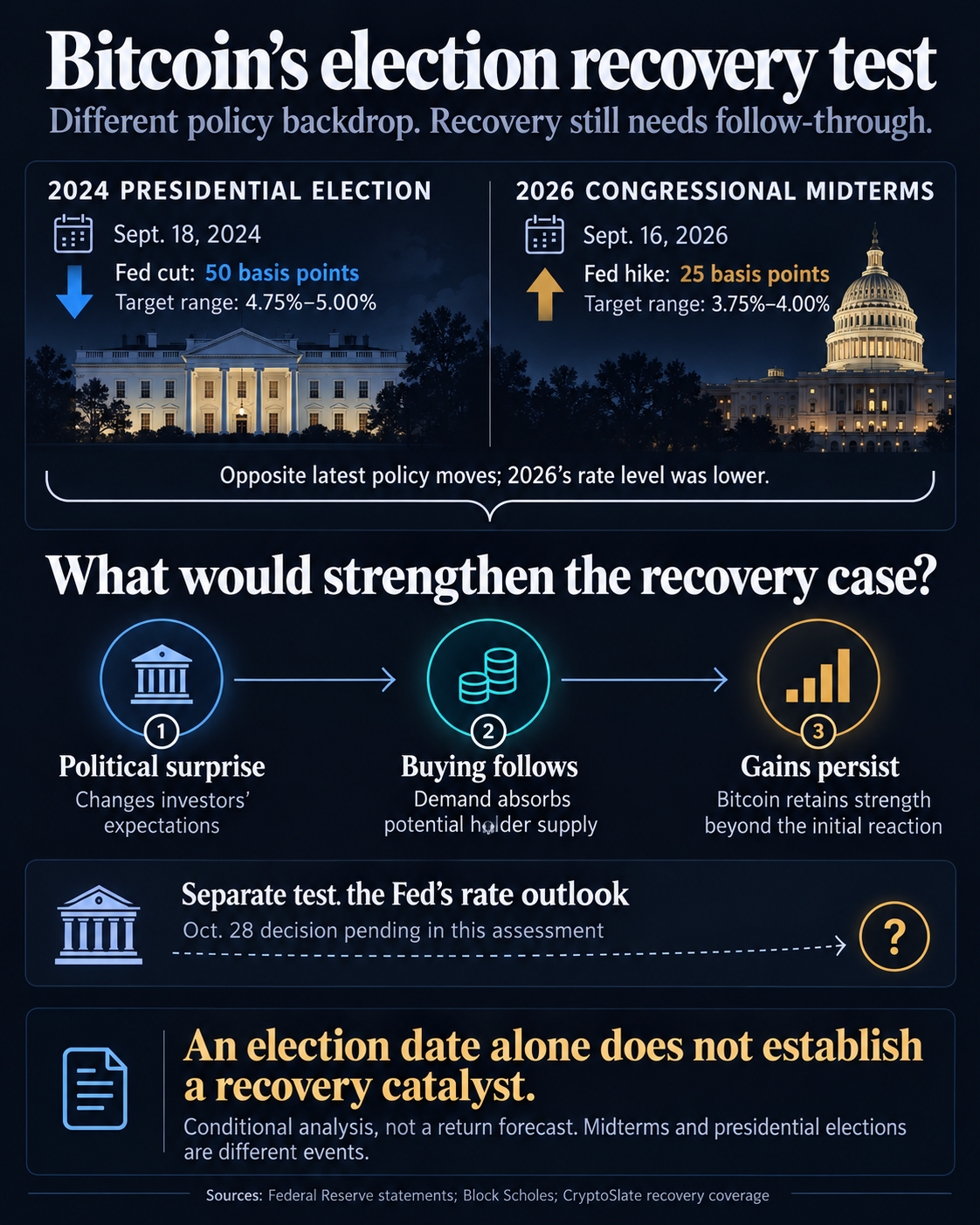
The Fed held that vary on October 28 in a ten–2 vote, with Lisa D. Prepare dinner and Beth M. Hammack preferring a quarter-point improve. Its subsequent assembly is scheduled for December 8–9.
The October 26 choices comparability predates that maintain. Future modifications within the price outlook stay a separate take a look at from the election outcome.
There’s a concrete value take a look at alongside these political and financial questions. mycryptopot’s October 27 restoration protection, citing Bitfinex, described a failed rebound towards $84,930 and a focus of holder acquisition costs between $81,000 and $82,500.
That October 29 quote places Bitcoin beneath the beforehand reported acquisition-price zone. These holdings will not be confirmed promote orders, so the vary can’t set up an inevitable rejection. Holders who purchased close by could reply in another way as costs revisit their buy ranges.
An election-led restoration would turn into extra convincing if modified political expectations have been accompanied by shopping for robust sufficient to maintain positive factors by that space. Continued rejection would go away the restoration query unresolved, regardless of the political narrative.
Historical past provides no computerized reply. Block Scholes cautions that earlier post-midterm Bitcoin recoveries overlap with the asset’s cycle and different market occasions, making election results tough to separate.