
Federal Reserve employees analysis printed Oct. 30 finds that Treasury sellers can maintain financing prospects’ bonds after their very own public sale stock has largely cleared. That lingering lending makes use of balance-sheet capability, so falling inventories can provide an incomplete image of sellers’ capability to finance Treasury positions.
The examine estimates that every greenback of Treasury coupon issuance expanded supplier steadiness sheets by about 21 cents, with roughly two-thirds attributable to shopper financing. Its primary regression pattern covers eight giant bank-affiliated sellers from January 2016 by way of June 2025. These are historic estimates, moderately than measurements of October 2026 stress.
The mechanism separates proudly owning a bond from financing its proprietor. Sellers can promote Treasuries to prospects whereas persevering with to produce repo financing, short-term loans secured by the bonds. Because the New York Fed explains, sellers additionally borrow money to fund their lending to leveraged purchasers. Shifting the safety off stock needn’t finish that middleman function.
Within the Fed examine, the impact of coupon issuance on sellers’ lengthy positions dissipates inside roughly three days after issuance. The rise in reverse repo, the financing sellers present purchasers, stays measurable throughout the next week.
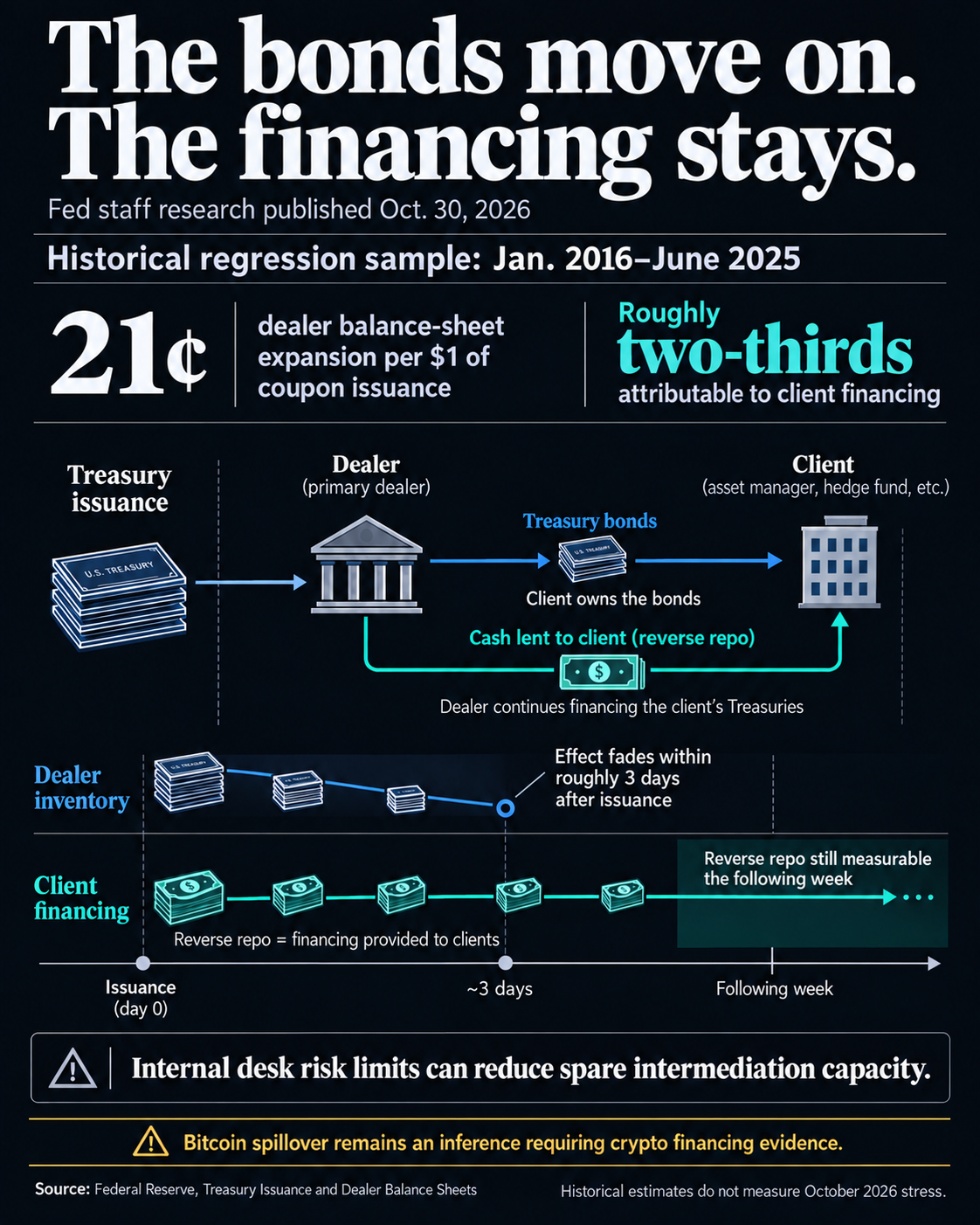
The examine associates issuance with better use of Treasury buying and selling desks’ inner threat limits, which might scale back spare intermediation capability. Its illustrative leverage-ratio calculations, nonetheless, put non permanent issuance results properly beneath mixture regulatory headroom. Out there room throughout sellers doesn’t set up spare capability at every desk.
New York Fed observations put the Secured In a single day Financing Charge, or SOFR, between 3.92% and three.95% throughout the 5 enterprise days from Oct. 23 by way of Oct. 29. The newest studying in that window was 3.94%.
The Federal House Mortgage Financial institution of New York’s Oct. 30 replace cites a 3.90% rate of interest on reserve balances and attributes SOFR buying and selling above it to Treasury provide, month-end and Canadian year-end. But it additionally describes financing situations as tranquil sufficient for the Fed’s reserve-management purchases to stay paused.
The lacking hyperlink between Treasury sellers and Bitcoin
If the identical constrained intermediaries fund Bitcoin merchants, cuts of their lending may transmit Treasury strain into crypto. That is still an inference about financing capability, not an noticed results of the Fed examine. The Financial institution for Worldwide Settlements’ April 2023 Crypto carry analysis identifies scarce arbitrage capital and leveraged investor demand as drivers of the hole between futures and spot costs. It additionally finds some segmentation between crypto and conventional markets, with interest-rate differentials explaining little of carry variation.
Treasury repo charges measure secured borrowing prices. Futures foundation measures a value hole. Perpetual funding, in the meantime, transfers funds between longs and shorts to anchor the contract to its index.
A stronger spillover case would pair persistent repo strain with worsening comparable crypto borrowing or rollover phrases. Establishing causation would require proof connecting constrained intermediaries to decreased Bitcoin financing. Steady crypto credit score phrases would weaken the spillover rationalization, even when Treasury financing remained costly.