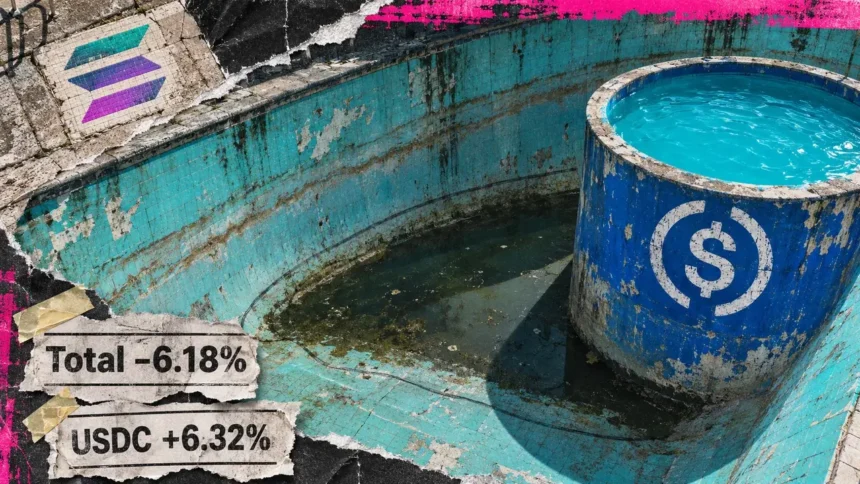
Solana’s stablecoin market is shrinking inconsistently. In information supplier DefiLlama’s Nov. 14 figures, the community’s complete stablecoin market capitalization was down 6.2% over 30 days, even because the tracked market cap of Circle’s USDC stablecoin rose 6.3%. Declines in USDT and several other different massive stablecoins outweighed that achieve.
The Solana desk put the full at $13.958 billion and USDC at $7.31 billion, representing 52.4% of the community’s tracked stablecoin market. The excellence adjustments the funding image: the mixture contraction stays, however it doesn’t describe each main stablecoin on the chain.
USDT and different declines outweigh USDC’s achieve on Solana
Tether’s USDT stablecoin stood at $2.053 billion, down 26.2% over the dashboard’s 30-day window. Calculations from the rounded balances and proportion adjustments indicate an roughly $729 million USDT decline. USDC’s corresponding improve was about $435 million, whereas the full stablecoin market cap fell roughly $919 million.
The approximate greenback adjustments are back-calculated from rounded present market caps and reported 30-day percentages. They measure shifts in tracked worth, reasonably than recognized money withdrawals or deposits.
The contraction prolonged past USDT. USD1, the World Liberty Monetary stablecoin, was down 26.0% to $1.046 billion, implying an roughly $368 million decline. USDGO fell 15.5% to $1.064 billion, or roughly $195 million on the identical calculation.
International Greenback, or USDG, declined 26.0%, whereas Ethena’s USDe fell 40.2%. Their estimated reductions have been about $156 million and $187 million, respectively. Collectively, these massive declining balances clarify why USDC’s enlargement might coexist with a smaller chain-wide complete. The proportion fall alone doesn’t present an asset’s contribution: USDe’s steeper contraction represented a smaller greenback change than USDT’s.
USDC additionally was not the one massive stablecoin rising on Solana. PayPal USD rose 14% to $782.99 million over the displayed 30-day window, implying a rise of about $96 million. The issuer breakdown reveals each enlargement and retreat inside the similar community.
Examine the 30-day adjustments
USDC and PYUSD grew, whereas USDT fell sharply. Percentages describe every asset’s market cap, reasonably than its share of Solana’s complete.
USDC grew on Solana whereas shrinking on Ethereum and globally. Reverse inventory adjustments don’t show direct transfers.
USDC’s development cushions Solana’s complete decline. It doesn’t reverse it.
Earlier balances and ‘different’ totals are derived from rounded inputs. Supplier 30d endpoints are usually not independently matched blocks. Market caps embody issued/bridged circulating belongings at value; they don’t set up money flows, switch routes or buying and selling depth.
Solana’s USDC development additionally contrasts with the identical asset elsewhere. On DefiLlama’s Ethereum dashboard, USDC stood at $41.386 billion, down 7.6% over the displayed 30-day interval. The worldwide desk confirmed $69.2 billion, down 4.9%.
These Nov. 14 comparisons use the supplier’s displayed 30-day home windows, reasonably than independently matched blockchain endpoints. They present the place tracked balances modified, with out figuring out the transactions behind these adjustments.
The outcome helps a narrower conclusion than a uniform retreat from USDC: its tracked steadiness expanded on Solana whereas declining on Ethereum and globally. Reverse adjustments alone don’t set up that Ethereum holders moved these funds on to Solana.
That distinction provides to mycryptopot’s Nov. 11 Solana protection, which examined concentrated derivatives turnover and combination stablecoin contraction utilizing Nov. 10 observations. The present issuer cut up reveals what the chain-wide determine conceals.
What the balances measure
DefiLlama’s definition measures circulating stablecoins multiplied by value, excluding burned and non-issued tokens. Chain totals embody belongings issued or bridged onto the community. These figures due to this fact differ from a native-only token rely or the reserve belongings held by an issuer.
DefiLlama’s USDC monitoring code distinguishes regionally issued tokens, tokens held again from circulation and bridged belongings on Solana. The dashboard complete doesn’t reveal which element explains the 30-day improve.
Circle’s Cross-Chain Switch Protocol illustrates why a chain-level improve needn’t imply new money entered the system. CCTP strikes USDC by way of burn-and-mint transfers between blockchains with out conventional bridge liquidity swimming pools. That may be a doable mechanism for relocating present USDC, not proof that CCTP triggered the rise measured right here.
Treasury stock introduces one other distinction. Tether says approved however unissued tokens stay exterior circulating market capitalization, and redeemed tokens can keep in treasury reasonably than being burned. A mint or burn rely alone wouldn’t reconcile the change in circulating balances.
Solana consequently has a smaller tracked stablecoin base with a distinct composition. USDC’s enlargement cushions the general decline, with out reversing it. That’s proof of an uneven contraction throughout stablecoins; the steadiness information alone can not present recent SOL shopping for or deeper buying and selling liquidity.