
Bitcoin Core disclosed three AI-discovered safety vulnerabilities that might disrupt nodes, together with one permitting attackers to remotely crash Home windows and Mac programs.
The Oct. 28 disclosures recognized two medium-severity memory-exhaustion vulnerabilities and a low-severity file-overflow flaw, exposing weaknesses in software program used to validate transactions and preserve the Bitcoin community.
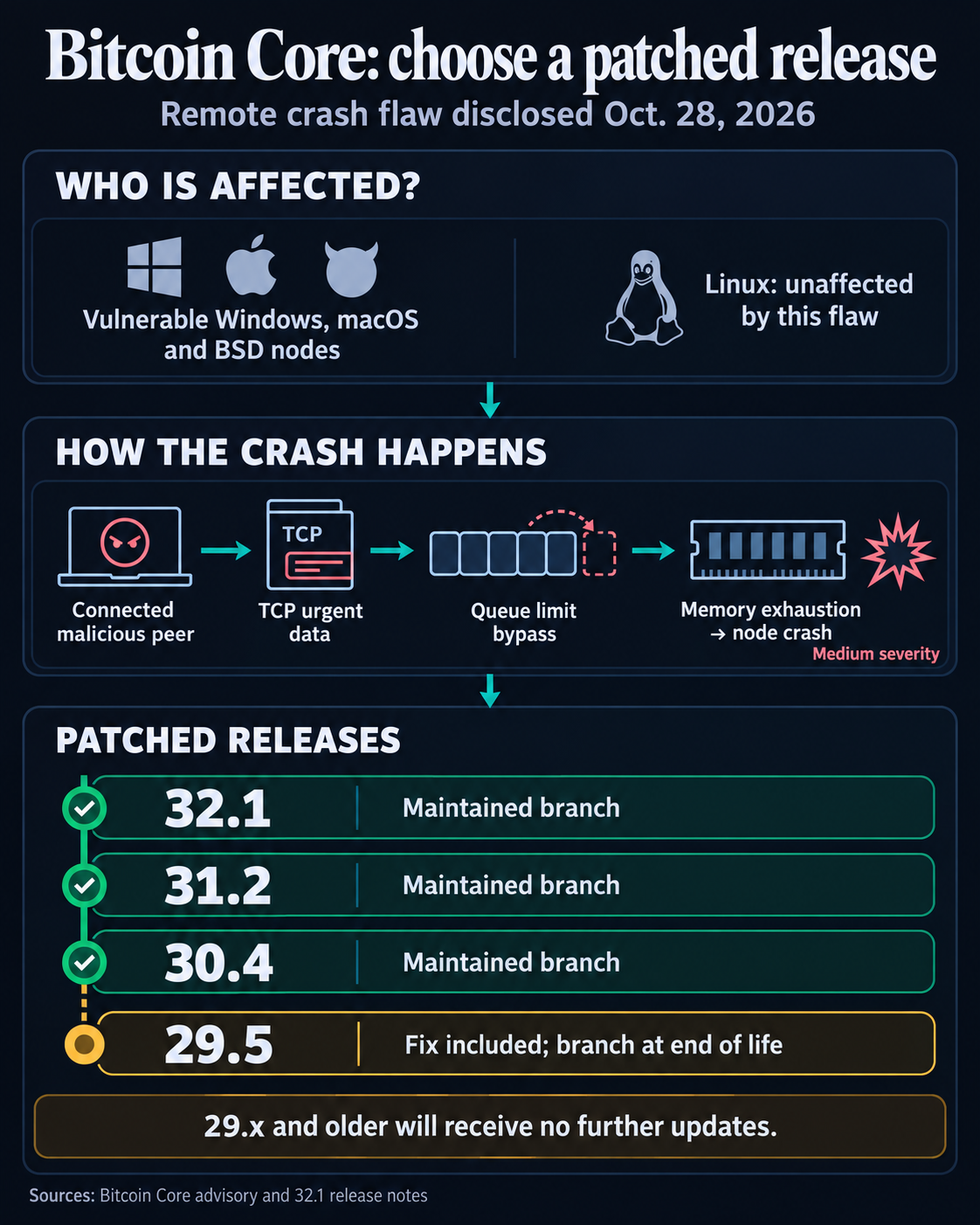
Builders launched fixes in variations 29.5, 30.4, 31.2 and 32.1 after automated massive language mannequin (LLM) scanning found them. The findings spotlight synthetic intelligence’s rising capacity to determine safety weaknesses in crucial cryptocurrency infrastructure.
AI scanning exposes Bitcoin node vulnerabilities
Essentially the most instantly exploitable flaw permits a malicious peer to overwhelm Bitcoin nodes working on Home windows, macOS, and BSD by sending specifically crafted community information.
In accordance with Bitcoin Core’s advisory, the vulnerability bypasses safeguards designed to restrict incoming information, permitting reminiscence consumption to extend till the affected node crashes.
Linux programs are unaffected by this specific flaw as a result of they use a unique mechanism for monitoring community connections.
A second medium-severity vulnerability impacts how Bitcoin Core communicates with older friends that don’t assist a community function launched beneath Bitcoin Enchancment Proposal 31.
Malicious friends might exploit the mechanism to build up outgoing messages indefinitely, growing reminiscence consumption by as much as 2 megabytes per hour per inbound connection and 5 megabytes per hour per outbound connection.
The ensuing stress might ultimately exhaust a node’s accessible reminiscence, disrupting its capacity to stay linked to the Bitcoin community.
The third vulnerability entails how Bitcoin Core handles recordsdata used to reverse transactions throughout blockchain reorganizations.
Beneath extremely uncommon circumstances, a miner might generate sufficient transaction information to overflow file-position limits, probably corrupting information wanted to course of reorganizations and forcing affected nodes to close down.
Bitcoin Core categorized the problem as low severity as a result of exploiting it on typical 64-bit programs would require mining 1000’s of specifically constructed blocks and engineering a exact blockchain reorganization.
All three vulnerabilities had been initially recognized by Venture Loupe, an automatic LLM-based safety scanning initiative developed by Elias Rohrer at Spiral.
Gregory Sanders subsequently validated the findings and alerted Bitcoin Core’s safety group.
The earliest vulnerability was found July 8, adopted by one other on Sept. 15 and the Home windows and macOS memory-exhaustion flaw on Oct. 23.
Builders accomplished the related patches on Oct. 26, launched up to date software program over the following two days, after which publicly disclosed the vulnerabilities.
The accelerated response displays Bitcoin Core’s safety coverage, which requires instant disclosure as soon as fixes turn out to be accessible for simply discoverable weaknesses, together with these detectable by comparatively easy AI-assisted scanning.
Beforehand, some vulnerabilities remained undisclosed for prolonged intervals beneath severity-based disclosure schedules.
The advisories didn’t report lively exploitation, however the technical particulars make upgrading particularly essential for operators nonetheless working susceptible software program.
Nevertheless, the patches don’t eradicate each publicity. Bitcoin Core warned that 32-bit programs and nodes storing blockchain information on FAT32 file programs stay prone to the file-overflow subject beneath particular circumstances.
The 32.1 launch notes additionally affirm that model 29.x and older branches have reached finish of life, leaving operators on these releases with out future safety updates even when they set up the 29.5 patch.
Operators transferring to maintained variations should account for compatibility necessities, together with macOS 14 or newer and Home windows 10 model 1903 or newer for Bitcoin Core 32.1. Upgrades from out of date releases might also require extra time for data-directory migration.